The latest trends in corporate events reveal a reality that, although many companies already sense it, few manage with the same firmness as the rest of their strategy: the moments that bring people together outside of work generate a type of trust that no meeting can replace. Some decisions are made at a dinner, during …

The latest trends in corporate events reveal a reality that, although many companies already sense it, few manage with the same firmness as the rest of their strategy: the moments that bring people together outside of work generate a type of trust that no meeting can replace. Some decisions are made at a dinner, during a break between presentations, or in the five minutes before a session begins.
The way a company brings its people together, presents its ideas, and builds relationships says more about its culture and ambition than any pitch deck. These are the trends redefining the sector and that leaders are integrating into their agenda.
1 – The event as an experience
The most important change happening in the world of corporate events is not technological but conceptual. Companies have stopped organizing events and started designing experiences.
A traditional corporate event has a program, a schedule, and a stage. A purposefully created experience has a complete narrative behind it. Attendees not only listen; they participate, interact, and take something with them. That “something” may be an idea, a conversation, or a feeling, which indicates whether the event has fulfilled its purpose or not.
2 – The attendee experience as a strategic priority
For years, events were designed from the organizer’s point of view: what needs to be communicated, who speaks, how long it lasts. Today’s dominant trend starts from a very different question: what does the attendee experience from the moment they confirm their attendance until they return home?
This has concrete implications that must be applied at every touchpoint of the event:
- The registration process and pre-event communication are part of the experience.
- The space, breaks, and catering shape much of the event’s perception.
- Informal conversation areas generate as much value as the main presentation.
- Post-event follow-up determines whether the event leaves a mark or is forgotten within 48 hours.
3 – Hybrid events: beyond a camera
Hybrid events have gone from being a solution to becoming a standard. But doing them well is far more complex than connecting a screen and hoping everything works. Hybrid events that truly succeed are those that treat the remote audience as a full-fledged audience.
Some key elements that distinguish a well-executed hybrid event are:
- Reusable content generated naturally as a result of the event itself.
- Specific production for each channel: in-person and remote require different approaches.
- Active moderation that integrates questions and participation from both audiences in real time.
- Technology that ensures the same quality of experience regardless of location.

4 – Sustainability
Sustainability entered the corporate event agenda long ago and today is almost a priority. Not as a marketing label, but as a real criterion that more and more companies apply when choosing suppliers, spaces, and formats.
Leadership teams with consolidated ESG policies know that the inconsistency between declared values and operational decisions carries a high reputational cost. In practice, this translates into concrete questions before choosing a venue:
- Does the venue have verifiable environmental certifications?
- Does the catering use local and seasonal products?
- Is there an active waste management policy during the event?
- Does the location facilitate access by public transport and reduce mobility footprint?
Organizing an event with sustainability criteria is not just a statement of intent: it is brand coherence.
5 – The return of in-person events
In an environment where technology allows anyone to connect from anywhere, paradoxically, in-person events are becoming more valuable. Precisely because they are no longer the only option, choosing to meet face-to-face carries more symbolic weight than ever.
In-person events have become a strategic decision because only in-person events can generate:
- Joint decision-making that requires trust and contextual understanding.
- Internal culture building and a sense of belonging in dispersed teams.
- Strengthening of alliances with clients or partners that go beyond transactions.
- Moments of recognition and cohesion that have no digital equivalent.
A well-executed in-person event is, today, one of the most valuable assets a company can activate.
6 – The venue as a strategic variable
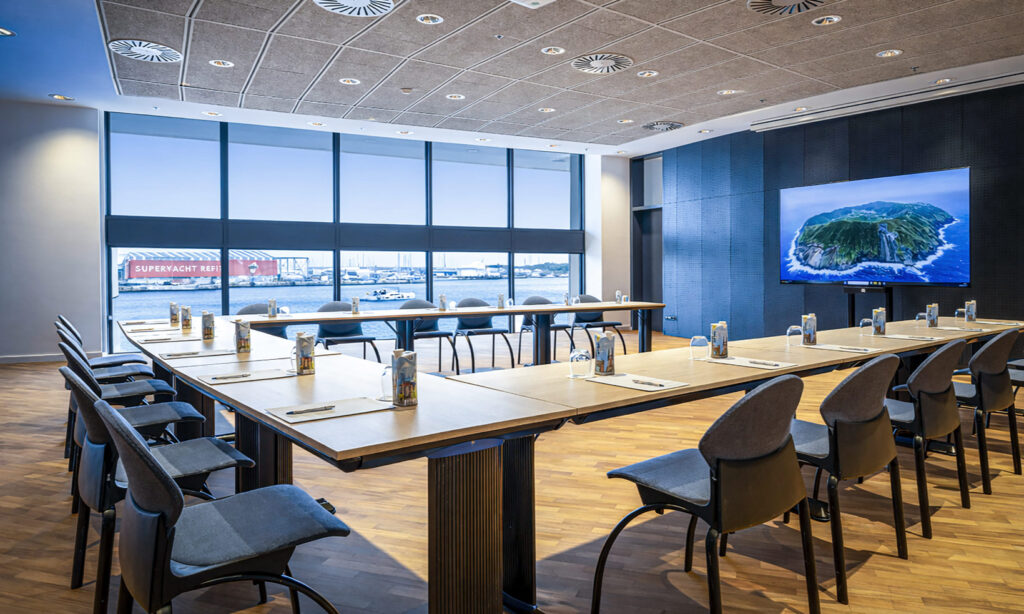
One of the clearest trends in high-level event organization is elevating the venue to a strategic variable, not a logistical one. It is no longer just about finding a space with enough square meters and chairs; it is about choosing an environment that communicates the event’s purpose.
The space where a company holds its annual convention or gathers its top clients says a lot about how it perceives itself. Some of the criteria applied to choosing the right venue are:
- A location that facilitates attendance and creates impact from the first moment.
- An environment that communicates the corporate message without needing to explain it.
- Flexibility to adapt the space to the event’s required format.
- Integrated services that eliminate logistical friction and allow focus on what truly matters.
An exclusive and well-managed environment is not a luxury; it is an investment in the company’s narrative.
If you are planning your company’s next corporate event and are looking for a venue that matches your objectives, WTC Barcelona offers more than 7,000 m² of versatile, bright rooms equipped with state-of-the-art technology, in a unique location facing the Mediterranean.
A team specialized in corporate events accompanies you from the first inquiry to the final detail, so you can focus on what matters: ensuring the event is a success. Contact us with no obligation.
And if you want to stay up to date on all the trends and news in the world of corporate events, you can find more articles like this on our blog.